
Earlier signals
Correlate changes in admissions, medicine use, wastewater, mobility, and other monitored inputs before conventional reporting alone reveals a trend.
Bio-Robotix combines clinical, environmental, pharmaceutical, mobility, and genomic signals with mechanistic epidemic models to surface emerging risk before it becomes a crisis.
Epidemic intelligence
Multi-source signal fusion
Data acquisition
Clinical, pharmaceutical, environmental, mobility, social, and genomic signals.
Statistical sensing
Calibrate noisy signals and identify emerging patterns.
Mechanistic epidemic modelling
Represent disease progression, transmission, and geographic spread.
Hybrid fusion (HDMR)
Fuse mechanistic outputs and statistical evidence into a risk surface.
Prediction and decision support
Translate model outputs into operational public-health views.
Epidemics are multi-scale biological and social events. Hybrid modelling connects data-driven sensing with interpretable disease dynamics, so teams can detect anomalies, test plausible scenarios, and understand the drivers behind each forecast.
Correlate changes in admissions, medicine use, wastewater, mobility, and other monitored inputs before conventional reporting alone reveals a trend.
Pair statistical anomaly detection with SEIR, agent-based, viral-kinetics, and spatial models to make assumptions visible and reviewable.
Use sensitivity analysis and cross-verification to identify dominant drivers, quantify uncertainty, and prioritize response options.
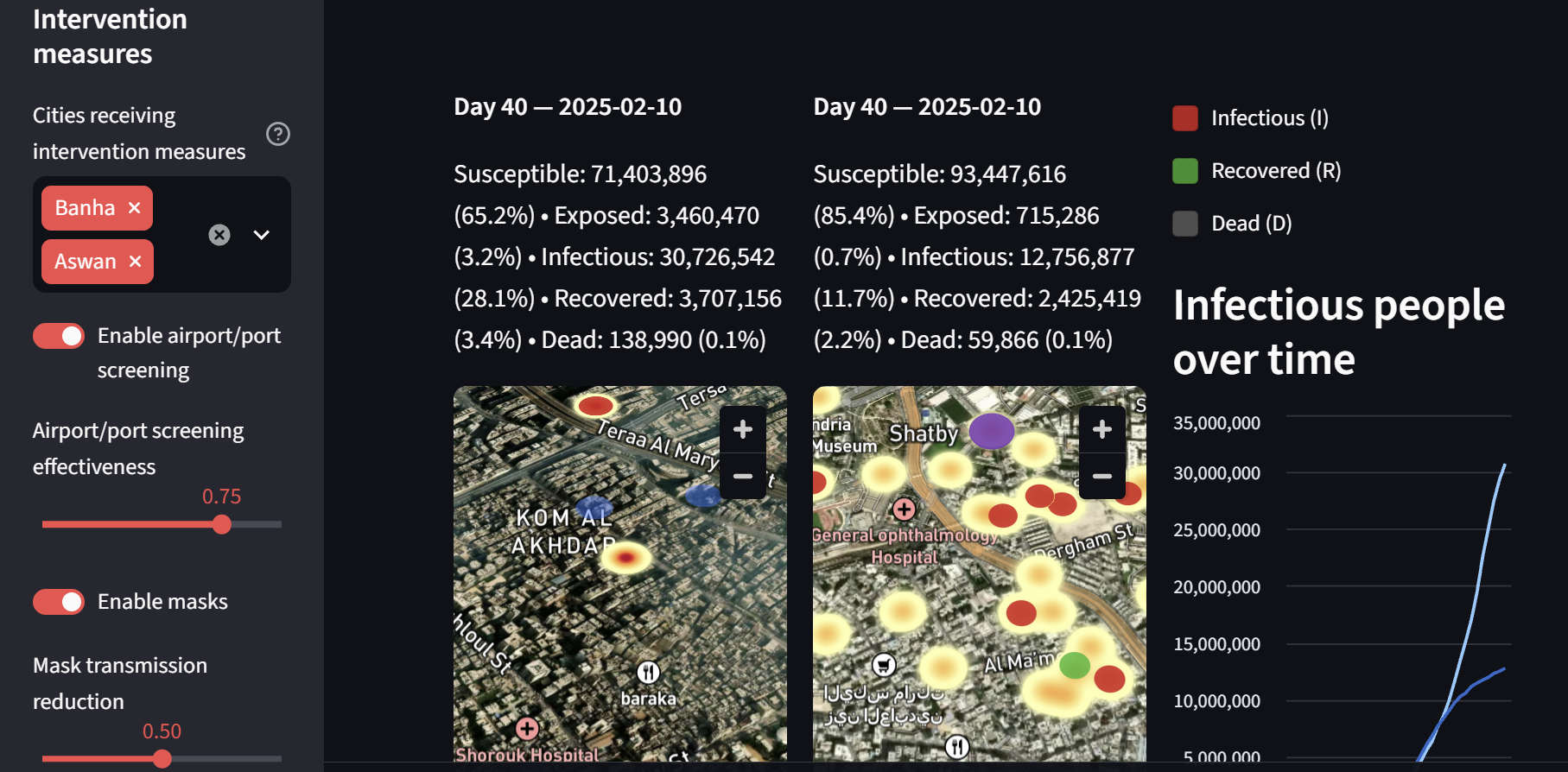
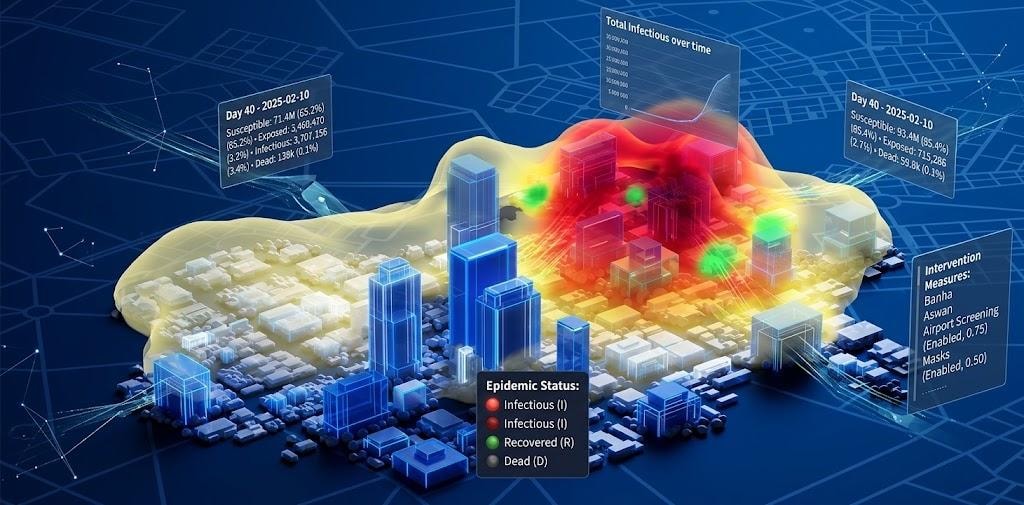
This spatial view brings projected spread, current infectious pressure, and intervention scenarios into a single, interpretable city model. Teams can compare hotspots over time and focus response planning where it may have the greatest effect.
01
Clinical, pharmaceutical, environmental, mobility, social, and genomic signals.
02
Calibrate noisy signals and identify emerging patterns.
03
Represent disease progression, transmission, and geographic spread.
04
Fuse mechanistic outputs and statistical evidence into a risk surface.
05
Translate model outputs into operational public-health views.
Bio-Robotix's biosurveillance engine fuses statistical machine learning with mechanistic viral models in a continuous eight-stage pipeline. Each layer refines the signal — from hospital and environmental data collection through to geo-referenced outbreak forecasts and actionable intervention plans.
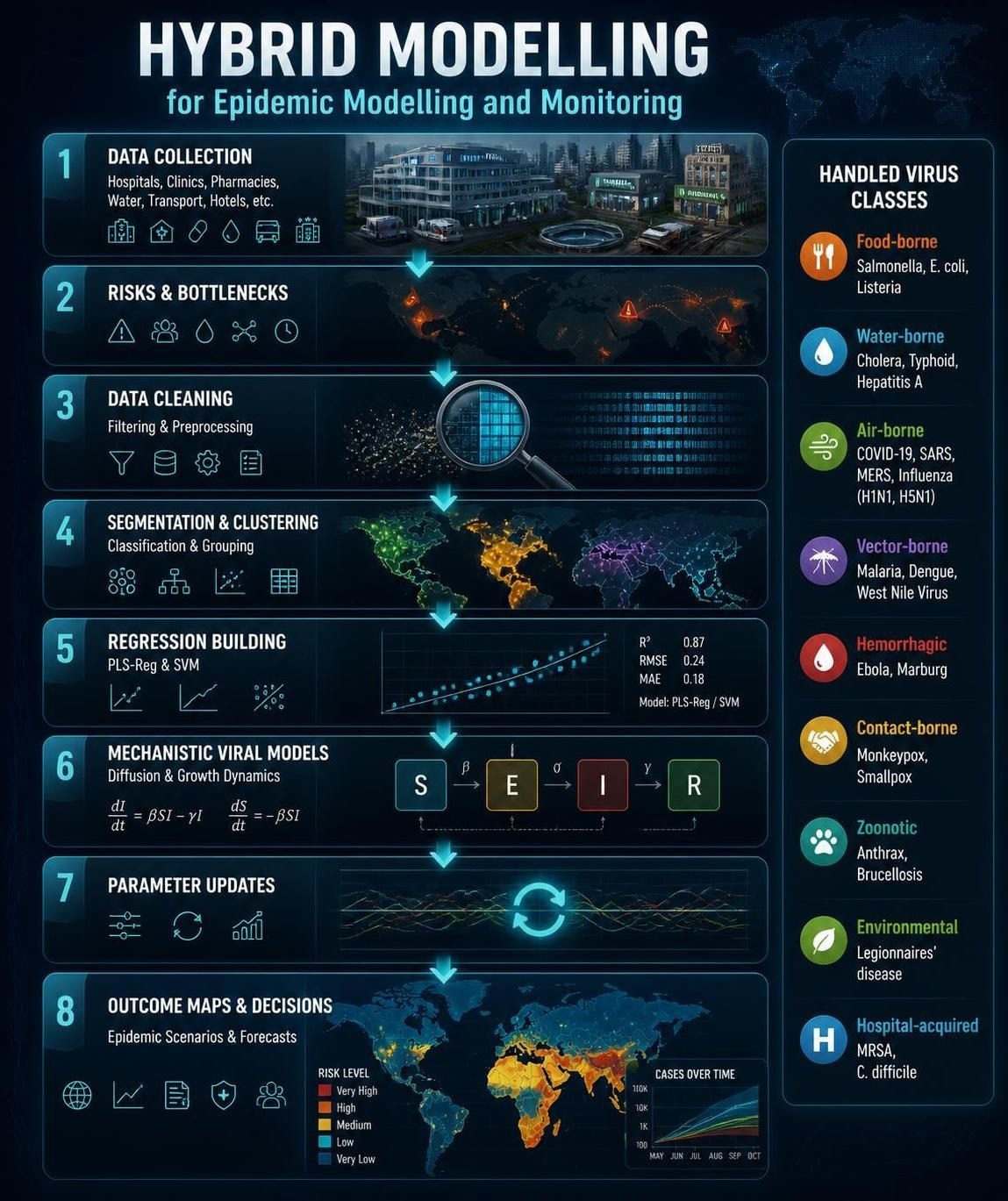
Ingests real-time feeds from hospitals, clinics, pharmacies, water utilities, transport networks, and hotels. Multi-source aggregation ensures no single point of failure and captures both clinical and environmental signals simultaneously.
Automated risk scoring identifies population density hotspots, supply-chain vulnerabilities, and infrastructure chokepoints that could accelerate transmission or impede response — flagged before modelling begins.
Filtering and preprocessing removes duplicates, corrects temporal misalignments, and normalises units across heterogeneous sources. Clean, validated data is the foundation every downstream model depends on.
Unsupervised classification groups geographic zones, demographic cohorts, and pathogen strains by behavioural similarity. Clusters reveal hidden transmission corridors that aggregate statistics would otherwise mask.
PLS-Regression and Support Vector Machine models quantify the statistical relationships between environmental drivers and case counts. Validated against held-out data (R² 0.87, RMSE 0.24, MAE 0.18), these models provide calibrated short-range forecasts.
SEIR compartmental equations (dI/dt = βSI − γI) encode the biological dynamics of transmission, incubation, and recovery. Mechanistic structure ensures forecasts remain physically plausible even when statistical signals are sparse.
Bayesian and ensemble methods continuously re-estimate transmission rate β, recovery rate γ, and latency period σ as new surveillance data arrives. Adaptive parameters keep the model calibrated to evolving outbreak conditions.
Geo-referenced risk maps stratified by Very High / High / Medium / Low / Very Low severity, paired with case-trajectory charts and scenario forecasts. Outputs feed directly into intervention planning, resource allocation, and public-health command dashboards.
HANDLED VIRUS CLASSES
Define data-sharing agreements, privacy controls, standards, and secure ingestion for clinical, pharmacy, environmental, mobility, and genomic sources.
Normalize streams, correct seasonality, detect outliers, and train PCA, PLS, SVM, clustering, and anomaly models on validated historical data.
Configure SEIR, agent-based, viral-kinetics, and spatial models using local demographics, contact patterns, mobility, and pathogen assumptions.
Use HDMR and Sobol analysis to combine evidence, evaluate uncertainty, and test forecasts against held-out events and expert review.
Deliver role-appropriate dashboards, alert thresholds, response playbooks, audit trails, and recurring model-review cycles.
Earlier, evidence-based signals help public-health teams focus testing, care capacity, and communication where they are most needed.
Transparent assumptions, confidence ranges, and observable drivers can help decision-makers explain actions with greater clarity.
Shared risk views support hospitals, municipalities, laboratories, and emergency teams in planning together.
Forecasting demand supports earlier staffing, supply, and bed-planning decisions before pressure peaks.
Targeted, proportionate interventions can help protect workforce continuity, education, trade, and essential services.
Sensitivity analysis helps teams prioritize surveillance, testing, and response investments around the factors that matter most.
This interface is prepared for a future Python-backed model. When connected, it can accept scenario inputs, run approved model configurations, and return clearly labeled forecasts, uncertainty ranges, and risk-map outputs.
Bio-Robotix biosurveillance concepts are designed to support qualified public-health and research teams. Outputs should be validated, governed, and interpreted alongside local epidemiological expertise and applicable privacy requirements.