Aerial view of agricultural crop fields monitored by Bio-Robotix swarm
Agricultural Platform

Autonomous Biosurveillance for Modern Agriculture

Swarm-intelligence micro-robots that continuously monitor crop fields, greenhouses, and storage facilities — detecting biological threats before they become outbreaks.

>95%Pathogen Detection Rate
0.3haCoverage per Unit/Hour
72hEarly Warning Lead Time
ZeroChemical Residue
Use Cases

Where the Agri Platform Deploys

Open-Field Crop Monitoring

Continuous autonomous sweeps across cereal, vegetable, and fruit crops. Detects fungal spores, bacterial blight, and insect vectors at sub-threshold densities — weeks before visible symptoms appear.

Fungal DetectionBacterial BlightInsect Vectors

Controlled Environment Agriculture

Greenhouse and vertical farm deployment. Micro-robots navigate between rows, monitoring humidity micro-climates, detecting Botrytis, Pythium, and other high-value crop pathogens in real time.

GreenhouseVertical FarmsBotrytisPythium

Post-Harvest Storage Facilities

Grain silos, cold stores, and packing houses. Continuous monitoring for mycotoxin-producing moulds, rodent activity, and temperature anomalies that signal spoilage risk.

Grain SilosCold StorageMycotoxinSpoilage Risk

Irrigation & Water Source Monitoring

Waterway and reservoir surveillance for algal blooms, Phytophthora, and waterborne pathogens that enter fields through irrigation — a primary but often overlooked infection vector.

Waterborne PathogensAlgal BloomsPhytophthora

Technical Specifications

Sensor Stack & Performance

Detection Sensors

Hyperspectral Imaging400–1000nm, 5nm resolution
Volatile Organic Compound (VOC)ppb-level sensitivity
Airborne Spore SamplingLaser diffraction, real-time
Soil Moisture & pHCapacitive + ion-selective

Navigation & Mobility

Navigation SystemRTK-GPS + SLAM fusion
Obstacle AvoidanceLiDAR + stereo vision
Swarm CoordinationB-ACO algorithm, mesh radio
Operating TerrainRows, uneven ground, slopes ≤30°

Operational

Battery Life8h continuous / auto-dock
Weather RatingIP67, wind ≤60km/h
Operating Temperature-10°C to +55°C
Data Uplink4G LTE / LoRaWAN / Satellite
Modular Platform Architecture

Eight-layer biosurveillance & CAP infestation control

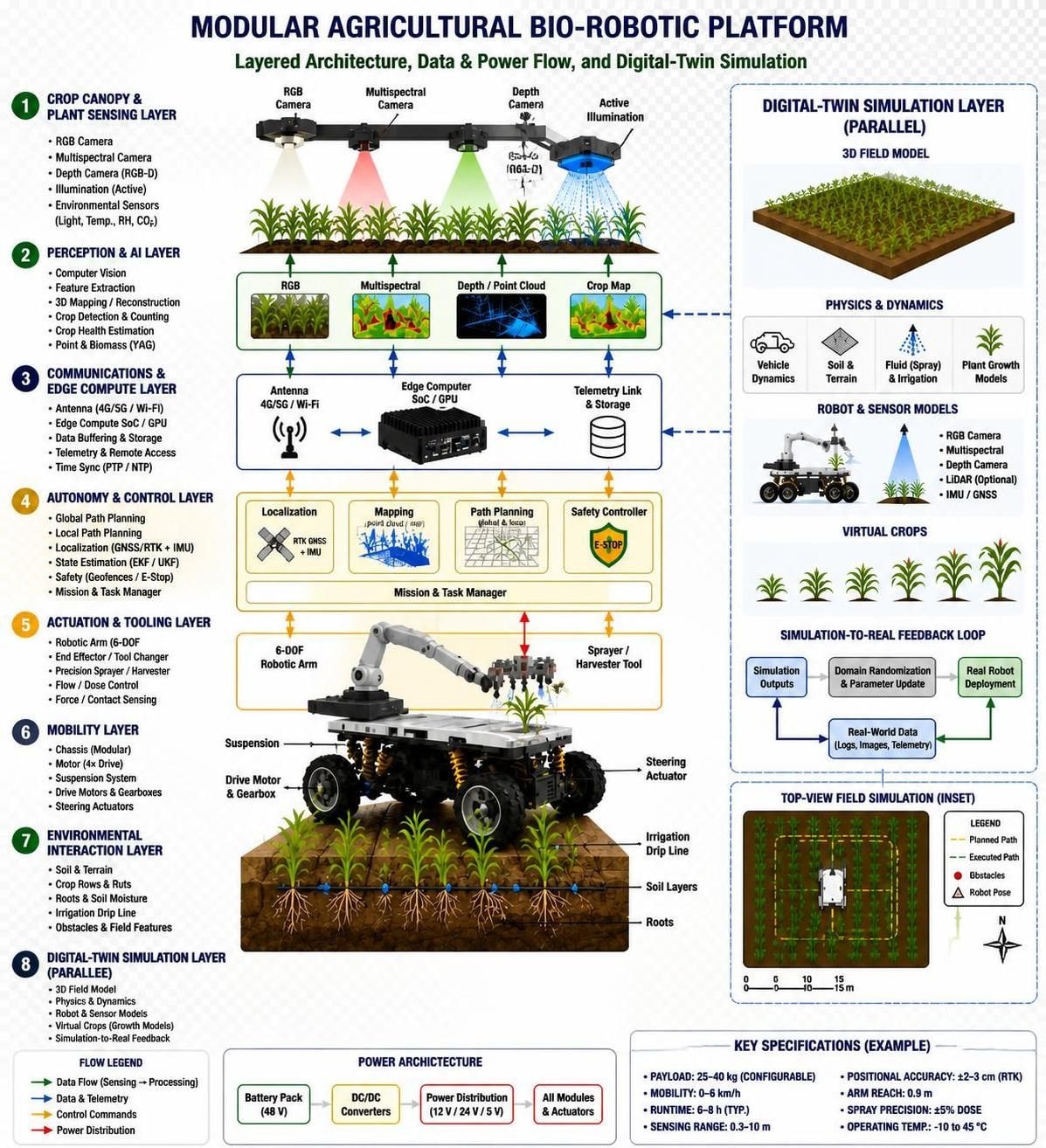
The Bio-Robotix ground robot integrates eight tightly coupled hardware and software layers — from raw multi-spectral sensing at the crop canopy through to autonomous Cold Atmospheric Plasma (CAP) treatment and a parallel digital-twin simulation loop. Each layer feeds the next, creating a closed-loop system that detects, classifies, and neutralises biological threats without human intervention.

1

Crop Canopy & Plant Sensing Layer

RGB, multispectral, and depth cameras combined with active illumination and environmental sensors (light, temperature, relative humidity, CO₂) capture a complete spectral and spatial picture of the crop canopy. This raw multi-modal data is the foundation every downstream layer depends on.

2

Perception & AI Layer

Computer vision and feature extraction pipelines convert raw imagery into 3D maps, crop counts, health estimates, and biomass measurements. Trained models detect disease lesions, pest signatures, and stress indicators at leaf level — flagging threats before they spread.

3

Communications & Edge Compute Layer

4G/5G/Wi-Fi antenna, an on-board SoC/GPU edge computer, and a telemetry-and-storage module process perception outputs locally in real time. Low-latency edge inference means treatment decisions are made in the field, not in a distant cloud.

4

Autonomy & Control Layer

RTK-GNSS + IMU localisation, point-cloud mapping, and global/local path planning keep the robot on precise row-by-row trajectories. Geofence and E-Stop safety controllers ensure the robot halts immediately if it encounters an obstacle or leaves its authorised zone.

5

Actuation & Tooling Layer

A 6-DOF robotic arm with a tool-changer end effector switches between a precision CAP sprayer and a harvester tool. Dose control and force/contact sensing ensure plasma is delivered at the correct distance and concentration for effective pathogen neutralisation without crop damage.

6

Mobility Layer

A modular chassis with four-wheel drive, independent suspension, and steering actuators navigates uneven terrain, crop rows, and irrigation ruts at 0–6 km/h. The platform carries a 25–40 kg configurable payload across 6–8 hour missions.

7

Environmental Interaction Layer

Soil and terrain models, root and moisture sensors, and irrigation drip-line awareness let the robot adapt its path and treatment plan to field conditions in real time — avoiding waterlogged zones, adjusting spray dose for soil type, and logging geo-tagged environmental readings.

8

Digital-Twin Simulation Layer (Parallel)

A parallel 3D field model running physics, fluid-spray, and plant-growth simulations continuously validates robot behaviour before deployment. A simulation-to-real feedback loop ingests telemetry logs and images from the field to update domain randomisation parameters, tightening the gap between virtual and physical performance.

KEY PLATFORM SPECIFICATIONS

Payload25–40 kg (configurable)
Mobility0–6 km/h
Runtime6–8 h (typical)
Sensing range0.3–10 m
Positional accuracy±2–3 cm (RTK)
Arm reach0.9 m
Spray precision±5% dose
Operating temp-10 to 45 °C
Modular Agricultural Bio-Robotic Platform diagram showing eight layered architecture components: crop canopy sensing, perception and AI, communications, autonomy and control, actuation and tooling, mobility, environmental interaction, and digital-twin simulation — with power architecture and key specifications
Full system architecture of the Bio-Robotix modular ground robot — eight integrated layers from multi-spectral crop-canopy sensing through to Cold Atmospheric Plasma treatment, with a parallel digital-twin simulation loop for continuous model refinement.
CAP Treatment

Cold Atmospheric Plasma infestation control

1

Threat detection & classification

The perception layer identifies the pathogen class — fungal, bacterial, viral, or pest — and maps its GPS-tagged location. Severity scoring determines whether immediate CAP treatment or monitoring is required.

2

Treatment zone planning

The autonomy layer generates a micro-path to the affected plant. The 6-DOF arm positions the CAP nozzle at the optimal standoff distance (0.3–10 m sensing range, sub-centimetre arm precision) for targeted plasma delivery.

3

Cold Atmospheric Plasma application

CAP generates reactive oxygen and nitrogen species (RONS) at ambient temperature and pressure. These species disrupt pathogen cell membranes and DNA without heat damage to the crop, leaving no chemical residue and requiring no withdrawal period.

4

Post-treatment verification

After treatment the robot re-images the zone. The AI layer compares pre- and post-treatment spectral signatures to confirm pathogen reduction. Results are logged with GPS coordinates, timestamp, dose, and outcome for traceability.

5

Digital-twin feedback

Treatment outcomes, environmental conditions, and robot telemetry are fed back into the digital-twin simulation. The fluid-spray and plant-growth models are updated, improving dose predictions for future missions in similar field conditions.

6

Fleet-wide learning

Anonymised outcome data from all deployed robots is aggregated to refine the central AI model. Each new deployment benefits from the collective field experience of the entire Bio-Robotix fleet.

AI & Data Intelligence

From Raw Sensor Data to Actionable Alerts

01

Contamination Probability Mapping

Real-time 3D field maps updated every 15 minutes. Risk zones colour-coded by threat severity and pathogen type.

02

Predictive Spread Modelling

Weather-integrated AI models forecast pathogen spread trajectories up to 72 hours ahead, enabling pre-emptive intervention.

03

Yield Impact Estimation

Correlates detection data with historical yield models to quantify economic risk and prioritise treatment zones.

04

Integration-Ready API

REST API and webhook support for farm management systems, ERP platforms, and agronomist dashboards.

Ready to Protect Your Crop?

Request a site assessment or reserve your agricultural deployment allocation.

Share this page